Drag Reduction
Active Flow Control for Transonic Airfoils
Reducing Friction Drag with Traveling Waves
Skin-friction drag in turbulent wall-bounded flows is a major contributor to the overall aerodynamic resistance of vehicles such as aircraft. For passenger airplanes during cruise flight, turbulent surface friction accounts for a large fraction of the total drag. Reducing this friction is therefore an important step toward improving energy efficiency and meeting future CO₂ reduction targets in aviation and other transport technologies.
Two main approaches exist for reducing turbulent skin-friction drag: passive and active flow control. Passive techniques modify the surface geometry but do not require external energy input. A well-known example is riblets, small streamwise-aligned surface grooves inspired by shark skin. Because they operate without additional energy consumption, riblets are attractive for practical applications, although their performance is typically optimized for a specific flow condition. In contrast, active flow control techniques introduce energy into the flow in order to modify turbulent structures more directly. While this requires actuation power, these methods are often adaptable to changing operating conditions and can potentially achieve higher drag reduction or even net energy savings. Many active strategies aim to influence the near-wall turbulence cycle, which is responsible for the production of turbulent skin friction.
One of the most extensively studied active techniques is the oscillation of the wall in the spanwise or streamwise direction. Numerical simulations first demonstrated that oscillating the wall laterally can significantly reduce turbulent drag by altering the interaction between the wall and the near-wall streaks and vortices. This oscillatory motion generates an oscillating spanwise shear layer close to the wall that weakens the turbulent structures responsible for high skin friction.
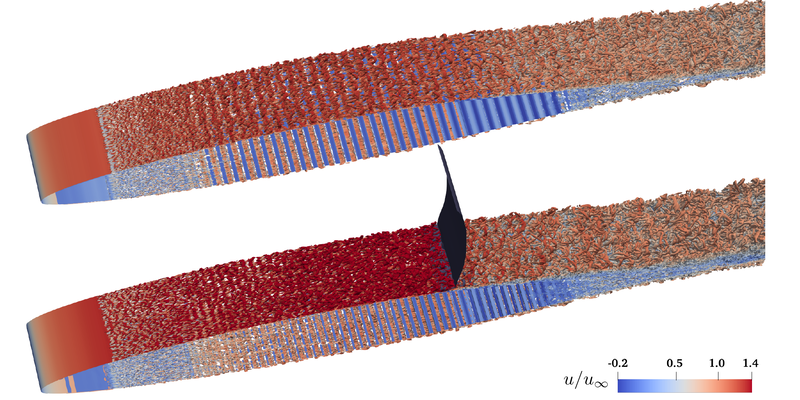
The figures shows contours of the Q-criterion visualizing the turbulent structures in the boundary layer around a DRA2303 airfoil equipped with streamwise traveling-wave surface actuation. The color scale represents the normalized streamwise velocity \(u/u_\infty\).
In the upper subfigure, the surface motion modifies the near-wall turbulent flow in subsonic conditions (Ma = 0.2),
leading to reduced skin-friction drag and lower pressure drag. The lower subfigure shows the streamwise traveling waves in transonic flow (Ma = 0.7), where the shock wave is visualized by the plane approximately normal to the airfoil.